

Start with where it collects
Surface dust and underwater buildup can look similar.
Before you skim or brush, look from the deck. Is the material on top of the water, around the waterline, or attached below the surface? That distinction is more useful than deciding from yellow or green alone.
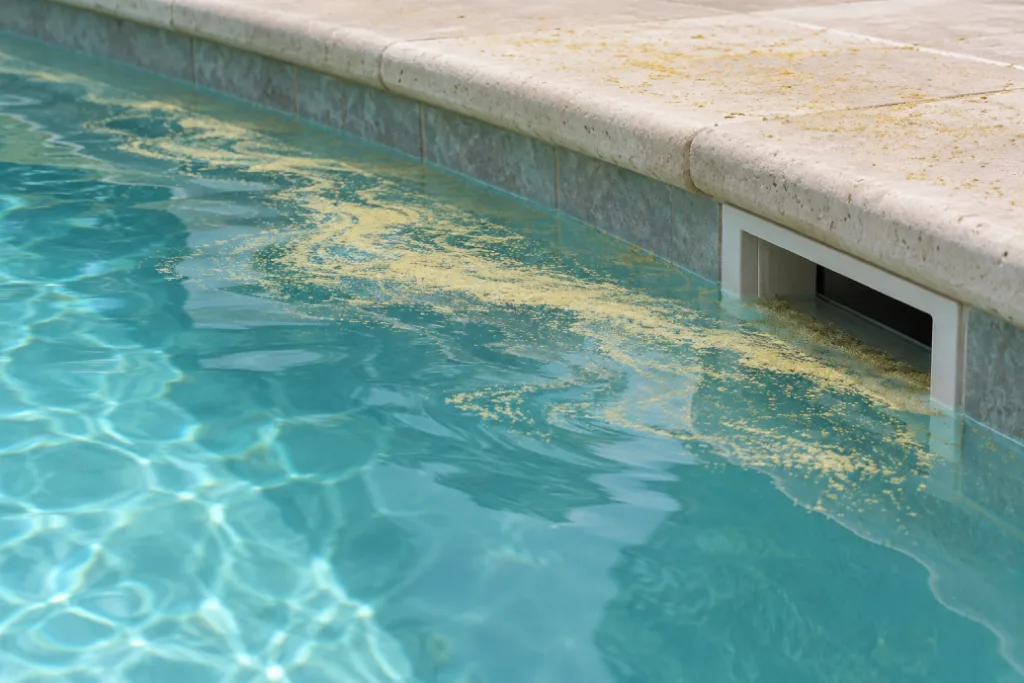
Pollen-like material at the surface
Loose powder may drift with the water and collect near the skimmer or tile line.
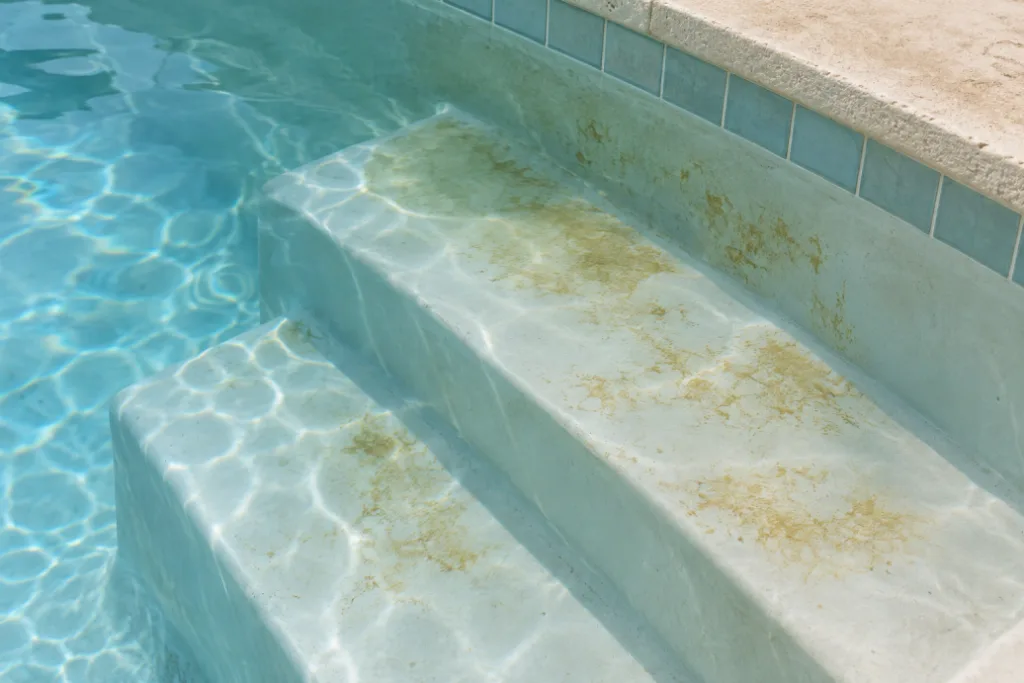
Yellow deposits below the surface
Dusty-looking patches on steps or walls can need an algae assessment, even when the surrounding water looks clear.
Appearance, location, and behavior
Compare the clues beyond the color.
These observations help you describe the problem and choose your next step without guessing at chemical doses.
| What to observe | Pollen may show | Algae may show |
|---|---|---|
| Color | Pollen may showYellow powder or a fine surface film. | Algae may showGreen water or yellow, dusty-looking deposits. Yellow does not rule algae out. |
| Texture | Pollen may showLoose particles that gather rather than a continuous coating. | Algae may showAttached growth or dusty patches. Mustard algae does not have to look like thick green slime. |
| Location | Pollen may showMaterial at the surface, tile line, or inside the skimmer; check nearby dry surfaces too. | Algae may showGrowth on submerged floors and walls, or algae suspended in the water. |
| When disturbed | Pollen may showLoose material moving with water or your skimmer net. | Algae may showA patch that brushes away. Mustard algae can lift easily, so a dust cloud is not a definitive test. |
| After cleaning | Pollen may showFresh material arriving from outside after earlier debris was removed. | Algae may showBuildup returning on submerged surfaces. Record the location and timing rather than assuming the cause. |
Not sure what the readings mean? Have your test results, recent products, storm date, and pool photos ready when you request green pool help. Do not mix chemicals or guess at a treatment dose.
The yellow-algae caveat
Brushing it away does not settle the question.
Mustard algae can resemble dirt or sand on the bottom or sides of a pool. BioGuard notes that it can brush off easily and return quickly. That is why “it turned into a puff of dust” is not enough to call a deposit pollen.
Photograph the same area before cleaning and when it reappears. Then compare that record with the water readings and equipment condition.
What if it keeps coming back?
Recurring deposits deserve a closer assessment. New airborne debris and unresolved growth are different explanations, and both need more context than a single photo.
What if the water is green?
Green algae can be attached or free-floating. Do not assume floating material is harmless because it moves. Keep swimmers out when the water is green or too cloudy to see the floor clearly.
Check before you treat
Four useful checks you can make from the deck
-
Record where the material sits
Take a wide pool photo and a closer photo of the deposit. Note the surface, skimmer, waterline, steps, wall, or floor. Include any similar dust on dry patio furniture or coping.
-
Test the water
Record free chlorine and pH using your test kit’s instructions. Include stabilizer readings if available and any recent products. CDC recommends pH 7.0–7.8, with chlorine guidance that depends partly on stabilizer use. A test helps assess water care; it does not identify a yellow particle.
-
Observe a small area while cleaning
If you can reach safely from the deck, use a brush suited to your pool finish. Note whether material lifts, stays attached, or returns. Do not enter murky water to inspect it or use an aggressive brush just to test a stain.
-
Note circulation and filter changes
Record pump operation, visible return flow, and any change from the normal filter-pressure reading. Keep these observations with the photos and readings so they can be reviewed together.
A water reading is not a chemical dose. Follow product instructions and get advice when the cause is unclear. Do not add shock, algaecide, or clarifier solely because a deposit looks yellow.
Choose the next step for your pool
Cleaning, recovery, or ongoing care?
Filtration and a fine-mesh skimmer can help collect pollen and other particles. How well fine material is captured depends on the equipment and its condition. Some material may remain even while the system is running.
Finding yellow debris in a basket or filter does not identify it. Likewise, clearer water after filtering does not establish that algae has been treated or the water is ready for swimming.
For loose surface material
Remove accessible debris and keep the normal water-care routine. Ask whether any filtration aid is suitable before adding it.
For attached or recurring buildup
Assess water chemistry and cleaning alongside filtration. A filter collects particles; it is not a substitute for addressing active growth.
For rising pressure or weak flow
Use your filter’s instructions and clean-filter baseline. Leave unfamiliar filter service to a pool professional, and never open a pressurized filter.
Send a pool photo
Show the location, not just the color.
A useful photo set shows the whole pool and the affected area. Take pictures from the deck before cleaning, then keep any later comparison with the date and water readings.
- A wide view of the water and surrounding pool
- A closer view showing the waterline, step, wall, or floor
- A photo or written record of your current test results
Contact BrockStar about your photos
Use the contact form to describe the material and ask how to share your photos. Include your Austin service address, when you first noticed it, whether it returned after cleaning, and any recent treatment.
You can also call to ask where to send the images.
Common questions
Before you call it pollen or algae
Pollen can collect at the tile line and inside the skimmer. That is different from identifying growth on a submerged wall. Location helps, but appearance alone is not enough to name the deposit.
Yes. Mustard algae can look like yellow dirt or sand on underwater surfaces. It may brush away easily, so yellow color and loose-looking texture do not rule it out.
It can help, along with surface skimming. Results depend on the filter and particle size, and new material can keep arriving. Do not treat what the filter catches as a diagnosis.
Test and assess first. The right next step depends on the material, water readings, pool volume, and product instructions. Yellow dust alone is not a treatment plan.
No. A photograph cannot measure sanitizer or confirm safe water conditions. Keep swimmers out when the water is green, murky, or the floor is not clearly visible; have the condition assessed and the water tested.